
Why Your Car Looks Different Under Every Type of Lighting
Why Your Car Never Seems to Look Exactly the Same
Have you ever noticed how your car can look flawless in the sunlight, noticeably darker in a parking garage, and almost like a different color under showroom lighting?
The paint itself has not necessarily changed. What changes is how light interacts with its surface.
So, why does your car look different depending on the type of lighting?
The answer comes down to light temperature, paint finish, and viewing angle. Each influences how we perceive color, gloss, and imperfections.
For Chicago drivers experiencing everything from bright summer afternoons to cloudy skies and artificial garage lighting, these differences are especially noticeable.
The Science Behind How Lighting Changes Your Car's Appearance
The way your vehicle looks depends on three main factors:
- Light Source: Different lighting produces different color temperatures, brightness levels, and reflections.
- Paint Surface: The color, texture, and finish determine how light reflects off the vehicle.
- Human Perception: Our eyes and brain adjust to surrounding lighting, influencing how we interpret colors.
Together, these factors explain why the same vehicle can appear warmer, cooler, brighter, or darker without any actual change to its paint.
Warm Lighting vs. Cool Lighting
Warm lighting, such as sunsets and traditional indoor bulbs, often makes paint appear richer, softer, or more golden.
Cool lighting, including certain LED lights and overcast daylight, can make colors appear sharper or slightly bluer.
Mixed lighting can create uneven color casts, making different body panels appear to have slightly different shades.
This can also involve metamerism, which occurs when two colors appear to match under one light source but look different under another. It is particularly relevant when evaluating previously repaired or repainted panels.
Why Your Car Looks Better in Direct Sunlight
Direct sunlight creates strong reflections that emphasize your vehicle's body lines, curves, and paint depth.
Metallic and pearlescent finishes often look especially vibrant because their reflective particles become more noticeable under intense lighting.
That brilliant shine, however, can come with a downside.
Sunlight Also Reveals Paint Imperfections
Bright sunlight can expose swirl marks, fine scratches, water spots, and surface haze that might otherwise go unnoticed.
Smooth, properly maintained paint reflects light more evenly, while imperfections scatter light and interrupt those reflections.
Sunlight does not create these defects. It simply makes existing imperfections easier to see.
This is why professional detailers use specialized inspection lighting to identify paint concerns before performing correction services.
Why Your Car Can Look Cleaner on Cloudy Days
Cloud cover acts like a natural light diffuser, softening reflections and reducing harsh shadows.
As a result, minor scratches, swirl marks, and surface imperfections may become less noticeable, making the paint appear smoother.
However, softer lighting can also reduce the dramatic reflections that give glossy paint its depth.
With Chicago's constantly changing weather, the same vehicle can look incredibly glossy one afternoon and noticeably flatter the next.
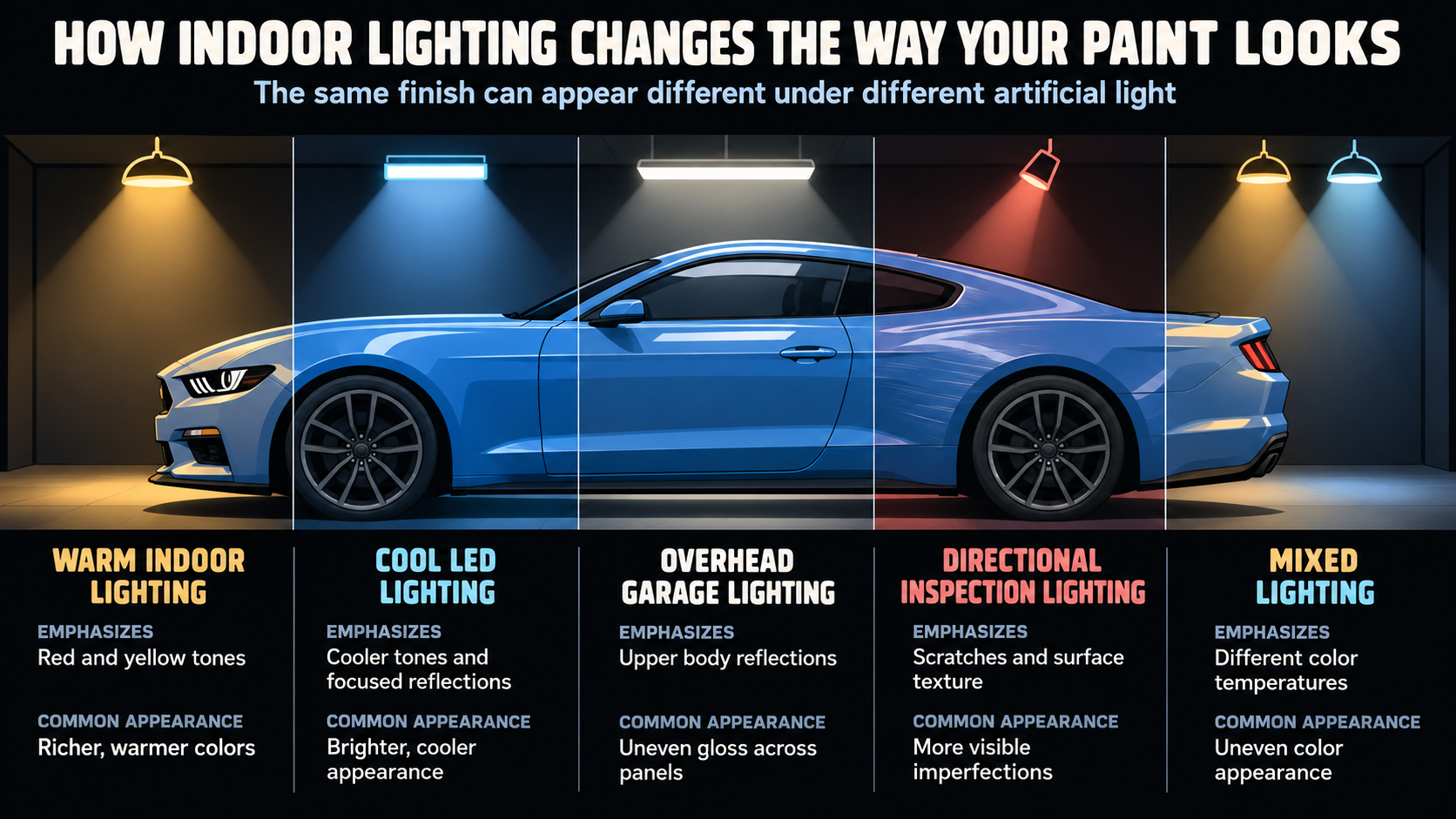
How Indoor Lighting Changes the Way Your Paint Looks
Showrooms, parking garages, and detailing facilities use different types of artificial lighting, each affecting how automotive paint appears.
Some lights emphasize color, while others reveal surface imperfections or create uneven reflections.
| Lighting Type | What It Emphasizes | Common Appearance |
|---|---|---|
| Warm Indoor Lighting | Red and yellow tones | Richer, warmer colors |
| Cool LED Lighting | Cooler tones and focused reflections | Brighter, cooler appearance |
| Overhead Garage Lighting | Upper body reflections | Uneven gloss across panels |
| Directional Inspection Lighting | Scratches and surface texture | More visible imperfections |
| Mixed Lighting | Different color temperatures | Uneven color appearance |
Why Professional Detailers Use Different Lighting
Professional detailers rely on different lighting conditions to evaluate paint accurately.
Specialized inspection lights help reveal swirl marks, fine scratches, and surface haze that ordinary garage lighting might conceal.
At Chicago Auto Pros, careful paint inspection is an important part of professional paint correction, helping identify imperfections and determine the appropriate approach to improving surface clarity.
Does Your Paint Finish Affect How It Reacts to Light?
Not all automotive finishes respond to lighting the same way. The type of paint influences how reflections, colors, and imperfections appear.
Solid, Metallic, Pearl, and Matte Paint
- Solid Paint: Generally offers a consistent appearance but can still look warmer or cooler depending on the lighting.
- Metallic Paint: Contains reflective flakes that become more noticeable in direct sunlight, creating additional depth and brightness.
- Pearlescent Paint: Can display different tones depending on the lighting and viewing angle, giving the finish a distinctive appearance.
- Matte and Satin Paint: Scatter light differently than glossy finishes, producing softer reflections and a more subdued look.
Ultimately, both color and finish determine how your vehicle responds to light. A metallic blue car may appear vibrant in direct sunlight and considerably darker in the shade, while a matte finish maintains a softer appearance with fewer sharp reflections.
Why Viewing Angle Makes a Difference
Have you ever walked around a metallic blue car and noticed how the color seems to change with every step?
As your viewing angle changes, light reflects differently across the vehicle's curves and body panels. Metallic and pearlescent finishes make this effect especially noticeable because their reflective particles interact with light at different angles.
A pearl white vehicle might appear bright and luminous from one direction but softer and darker from another.
These changes are completely normal and are part of what gives certain automotive finishes their distinctive appearance.
Can Lighting Reveal Paint Damage You Did Not Know Was There?
Some paint imperfections are nearly invisible until the right lighting exposes them.
Common examples include:
- Swirl Marks and Fine Scratches: Become more noticeable under direct sunlight or focused lighting.
- Water Spots and Mineral Deposits: Can interrupt reflections and leave visible marks on the finish.
- Paint Oxidation and Surface Haze: May cause paint to appear dull or cloudy under bright lighting.
- Uneven Polishing: Can create inconsistent reflections or visible polishing marks.
- Paint Color Differences: Previously repaired panels may appear mismatched under certain lighting conditions.
When Is a Change in Appearance Worth Investigating?
Not every difference in appearance indicates paint damage.
Metallic finishes, viewing angles, and changing light temperatures can naturally alter how a vehicle looks.
However, if one panel consistently appears different from the surrounding paint, or certain imperfections remain visible across multiple lighting conditions, a professional inspection may be worthwhile.
Evaluating the vehicle under different light sources can help determine whether the issue involves surface imperfections or paint color matching.
How Professional Detailing Helps Your Paint Look Its Best in Any Lighting
Professional detailing cannot change how light behaves, but it can improve the surface reflecting it.
Clean, properly maintained paint produces clearer reflections, while scratches and contamination can interrupt the finish.
Paint Correction Restores Clarity and Reflection
Professional paint correction helps reduce visible swirl marks, fine scratches, and surface haze.
By carefully refining the clear coat, paint correction can improve reflection clarity and restore depth to the finish.
This is particularly noticeable on darker vehicles, where imperfections tend to stand out.
Ceramic Coating Enhances Gloss and Simplifies Maintenance
Ceramic coating can enhance the gloss of properly prepared paint while creating a hydrophobic surface that makes routine cleaning easier.
However, ceramic coating does not conceal significant scratches or replace paint correction.
Proper preparation remains essential for achieving the best appearance.
Paint Protection Film Helps Preserve the Finish
Paint protection film, commonly known as PPF, helps protect vulnerable painted surfaces against rock chips, minor scratches, and road debris.
Preserving the underlying paint helps maintain its appearance over time, particularly for vehicles regularly exposed to Chicago traffic and construction.
At Chicago Auto Pros, paint correction, ceramic coating, and PPF offer different ways to improve or preserve a vehicle's finish based on its condition and protection needs.
How to Properly Inspect Your Car's Paint at Home
You do not need professional equipment to get a better understanding of your vehicle's paint condition.
Try these simple inspection techniques:
- Use Indirect Daylight: Examine the vehicle in bright, shaded conditions for a balanced view of its color and finish.
- Check Direct Sunlight: Look for swirl marks, fine scratches, and surface haze.
- Compare Different Angles: View body panels in both sunlight and shade to identify unusual color differences.
- Inspect Reflections: Look for water spots, contamination, and inconsistent gloss.
- Use Multiple Lighting Conditions: Avoid judging paint correction or ceramic coating results under only one light source.
If a previously repaired panel consistently appears mismatched, consider having it evaluated professionally.
Why Chicago Auto Pros Pays Attention to the Details You Might Not See
A vehicle can appear flawless under ordinary garage lighting while revealing imperfections in direct sunlight.
That is why proper paint inspection and surface preparation are important parts of professional automotive detailing.
At Chicago Auto Pros, evaluating paint condition helps determine the appropriate approach to detailing, paint correction, and protective services.
Whether the goal is improving surface clarity, enhancing gloss, or preserving the finish with ceramic coating or PPF, understanding the condition of the paint is essential to achieving quality results.
Wrap Up
Your Paint Is Not Changing, but the Way You See It Is
Your car looks different under various lighting conditions because light temperature, intensity, direction, paint finish, and viewing angle all influence its appearance.
Direct sunlight highlights gloss and imperfections, cloudy skies soften reflections, and artificial lighting can change how colors appear.
While these differences are generally normal, maintaining a clean and properly cared for finish helps your vehicle look its best in different environments.
Want your vehicle to look its best in any lighting? Contact Chicago Auto Pros to explore professional detailing, paint correction, ceramic coating, and PPF services tailored to your vehicle.
Share with your friends

We Make Your Car Look Beautiful
Founded with an unquenchable desire for automotive perfection, Chicago Auto Pros is a leader in paint protection efforts and aesthetic vehicle detailing services in Chicago, Illinois. When you bring your automobile to our Chicago-based detailing shop, you are sure to experience unmatched integrity, customer service excellence, and above all, absolute automotive perfection from the inside out. Choose the right auto detailing team - choose Chicago Auto Pros!
Lombard Location
207a Eisenhower Lane South, Lombard, Illinois 60148, United States
Glenview Location
2075 Johns Ct, Glenview, IL, 60025, United States
St. Charles Location
315 Industrial Dr, St Charles, IL 60174, United States