

From Street to Sea: Detailing That Goes Offshore
From Street to Sea: Detailing That Goes Offshore
Chicago Streets Meet the Open Water
We built our reputation on land, on the glossed hoods of European coupes, on the mirror-finish fenders of luxury SUVs weaving through downtown Chicago. Every swirl removed, every panel protected, a mark of our boutique obsession with detail. But now, we’re going farther. Beyond the Loop, beyond Lake Shore Drive, offshore.
What happens when craftsmanship leaves the concrete and hits the current?
You get an evolution. A transformation in product, process, and mindset. As interest in marine detailing grows, so does the demand for detailers who can bring the same precision and care found in luxury automotive to the surfaces of boats, yachts, and even offshore structures.
This isn’t just a new service, it’s a new terrain. And the next frontier of paint correction and protection doesn’t run on four wheels, it floats.
What “Offshore Detailing” Actually Means
Offshore detailing goes well beyond a boat wash. It’s the specialized practice of cleaning, restoring, and protecting marine-grade surfaces, whether that’s a 40-foot sportfisherman moored in Belmont Harbor, or the rugged steel framework of a wind turbine standing sentinel in Lake Michigan.
We’re talking about vessels, yes, but also infrastructure. Yachts, sailboats, pontoons, and the occasional powerboat? Absolutely. But the same principles extend to offshore rigs, energy structures, and marine-grade components exposed to the elements 24/7.
The challenges? Let’s just say your average Audi doesn’t sit in saltwater. Where land-based vehicles deal with dust, grime, and the occasional snow-salt blend, marine surfaces face a relentless trifecta: salt corrosion, UV degradation, and organic invaders like algae and barnacles.
Put simply: Your daily driver gets dirty. Boats decay.
And that's exactly why the detailing game changes, because the environment demands it. And if you want lasting shine offshore, you need more than wax and elbow grease. You need strategy. You need science. You need a boutique detailer who understands the difference.
Street vs. Sea: A Breakdown of Differences
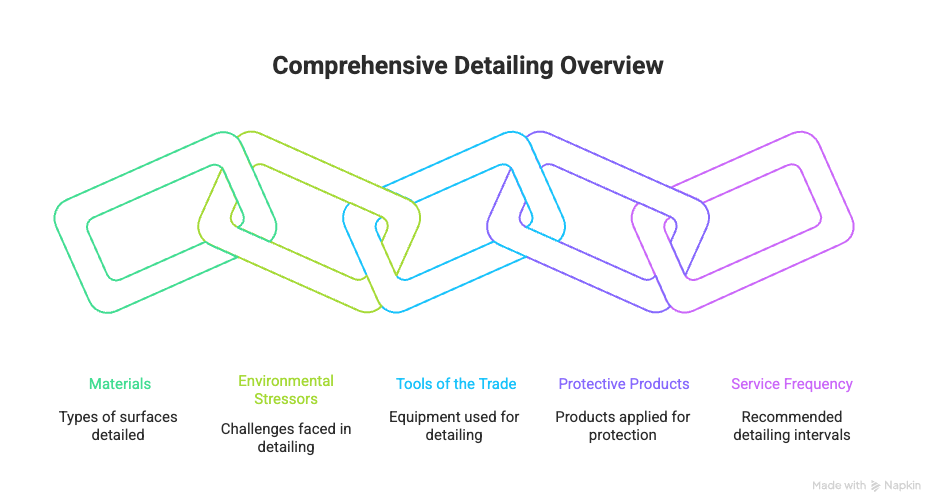
Bottom line?
Using automotive products on a boat isn’t just ineffective, it can be damaging. The marine world demands more than mirror shine; it demands resilience. And boutique detailing shops looking to go offshore need to rethink not just what they use, but how they use it.
Tools & Techniques of the Offshore Trade
The Full Detail, Wave by Wave:
1. Rinse & Remove Debris
First: a pressure rinse to wash away salt residue, algae film, and any clinging barnacles. This isn’t just cosmetic, it's a crucial prep step to protect surfaces during deeper cleaning.
2. Oxidation Treatment & Wet Sanding
Gel coats don’t just fade, they chalk. Removing oxidation often requires a combo of oxidation-specific compounds and, in severe cases, wet sanding. Precision is key, too aggressive, and you risk burning the surface; too soft, and oxidation remains embedded.
3. Rotary Buffing & Multi-Stage Polishing
Unlike dual-action polishers used in auto work, marine detailing often calls for rotary buffers. Why? Because gel coats are tougher, and more stubborn. We use medium-cut to ultra-fine polishes in a progression to rebuild that glassy finish.
4. Application of Marine-Grade Sealants
Protection comes last, but not least. Marine waxes and sealants are engineered to withstand salt spray, UV exposure, and wave impact. Applied in layers, they form a barrier that keeps oxidation at bay and shine intact.
5. Interior Care: UV Blockers & Mildew Defense
Cabin surfaces get their own routine. We use protectants with built-in UV blockers and mildew-resistant formulas on upholstery, consoles, and trim. A must for any vessel that lives dockside or under partial cover.
The Boutique Edge
Where standard marine services might aim for “clean enough,” a boutique-level approach pursues refinement. We obsess over the angles, chrome polishing, fine line sealing, teak brightening, not just for looks, but for longevity. Every step is a balance between artistry and preservation.
A Word on Expertise
Marine detailing isn't for rookies. Between the materials, techniques, and tools, one wrong move can cost thousands. That’s why transitioning from land to sea demands training, intention, and respect for the vessel. Especially when you're entrusted with a $200,000 yacht.
Why Go Offshore? The Opportunity Behind the Shift
The streets may be crowded, but the water? It’s wide open, and lucrative.
The Market Is Moving
Boat ownership is up. Yachts are no longer just status symbols; they’re mobile sanctuaries. The boating boom post-2020 created an influx of new vessels, many owned by first-timers who needed guidance and services. Couple that with an increase in marine tourism and offshore energy ventures, and you’ve got an underserved detailing frontier.
Bigger Jobs, Bigger Payouts
On the street, a luxury auto detail might run $150 to $300. Offshore? You’re talking $25–$75 per linear foot, and the average boat is 30 to 50 feet. That’s $750 to $3,750 per job, and that’s just exterior work. Add interior detailing, oxidation restoration, or multi-layer protection and those numbers climb fast.
Yes, the work is more demanding. Yes, the tools and products shift. But the margins? They’re just as impressive as the watercraft.
The ROI: Tools, Training, and Time
Learning marine detailing doesn’t require reinventing your business, it’s an add-on. One that elevates your brand and revenue. The investment in training and marine-grade products is quickly recouped with just a few well-booked boats per season. For Chicago Auto Pros, it’s not a pivot, it’s a stack.
Chicago’s Hidden Asset: Lake Michigan
You’re not landlocked. Chicago’s marinas are dense with potential clients: weekend boaters, yacht clubs, charter companies, offshore workers, and structural operators. From Burnham Harbor to Montrose, from leisure craft to commercial vessels, your next detailing appointment may be floating, not parked.
Beyond Boats: Industrial Offshore Detailing
Marine detailing doesn’t stop at the yacht club.
There’s a whole other layer of opportunity in offshore industrial structures, steel frameworks and platforms used in energy, shipping, and infrastructure projects. These aren’t polished for show, they’re protected for survival.
Materials That Fight Back
Offshore structures are built for battle. They face continuous salt spray, wave impact, and UV degradation. Detailing here means applying anti-corrosive coatings, surface prep, and marine-grade paints designed to delay oxidation and preserve structural integrity. These are not one-size-fits-all applications, they require precision, familiarity, and serious prep.
Techniques That Scale
From Hydra-Lok connections to modular fabrication, the world of offshore steel detailing is about accuracy and longevity. The techniques echo automotive principles, surface correction, protection, and restoration, but at industrial scale. And where some companies outsource this work overseas, boutique-level detailers offer something more: precision, accountability, and craft.
Where You Fit In
You don’t need to outfit an oil rig to get started. Begin with marine infrastructure, docks, cranes, fishing vessels, wind turbine components. Develop partnerships with marinas, offshore service providers, and vessel manufacturers. Your credibility in automotive detailing is a launchpad. Your attention to finish and function? That’s your ticket offshore.
Your Expansion Playbook
- Start with pleasure craft. Build marine detailing packages using your boutique ethos.
- Level up into commercial docks and vessels. Offer cleaning and preservation services.
- Network into infrastructure. Position yourself as a corrosion-prevention partner.
- Train your team. Equip them with the knowledge to adapt marine coatings and techniques safely.
Because the truth is: whether it’s steel, gel coat, or paint, when you understand how to preserve a surface, your value travels well.
The Boutique Advantage: Craftsmanship That Translates
Whether it’s a Bentley or a Bertram, high-end detail is high-end detail. What sets us apart isn’t just the tools or the products, it’s the philosophy. The relentless pursuit of a flawless finish, the respect for every curve and surface, the understanding that protection is just as important as presentation.
That doesn’t change when the vehicle trades tires for a transom.
We bring boutique-level standards to marine work because that's who we are, obsessive, precise, and unwilling to settle for “good enough.” Boats, like luxury cars, are investments. They deserve more than a rinse and wax. They deserve artisanship.
And if we’ve learned anything detailing through Chicago winters, it’s this:
“If we can protect a car from Midwestern winters, we can protect a hull from salt and sun.”
From bitter cold to beating rays, from pothole grit to tidal corrosion, we know how to fight back. And we do it beautifully.
Final Word
Detailing offshore isn’t just harder, it’s more rewarding. It challenges your skillset, sharpens your eye, and elevates your craft. And in return? You get access to a market that respects precision and pays for it.
Ready to go from the street to sea?
Book a marine detailing consultation with our seasoned, street-bred pros at Chicago Auto Pros. We’ll walk you through the process, show you the difference, and bring that boutique finish to whatever floats your fleet.
"From Chicago’s back alleys to the open blue, our obsession with perfection travels well."
Share with your friends

We Make Your Car Look Beautiful
Founded with an unquenchable desire for automotive perfection, Chicago Auto Pros is a leader in paint protection efforts and aesthetic vehicle detailing services in Chicago, Illinois. When you bring your automobile to our Chicago-based detailing shop, you are sure to experience unmatched integrity, customer service excellence, and above all, absolute automotive perfection from the inside out. Choose the right auto detailing team - choose Chicago Auto Pros!
Lombard Location
207a Eisenhower Lane South, Lombard, Illinois 60148, United States
Glenview Location
2075 Johns Ct, Glenview, IL, 60025, United States
St. Charles Location
315 Industrial Dr, St Charles, IL 60174, United States